Your AI Has No Goals — How Is It Supposed to Work for You?
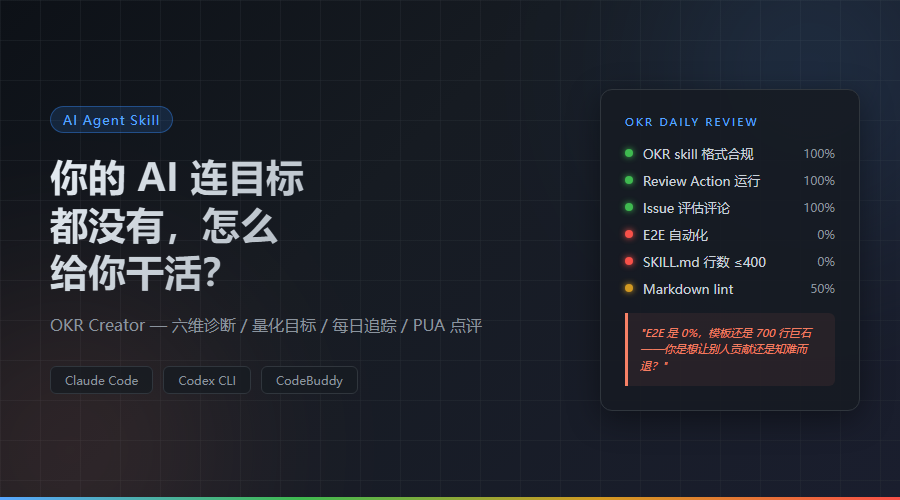
I built a tool that generates OKRs for projects, then made it manage itself with its own OKRs. Now it sends me a "performance review" every night and roasts me.
| Resource | Link |
|---|---|
| GitHub | github.com/chainreactors/okr-creator |
| Bootstrap Issue (updated daily) | Issue #1 |
| Bootstrap OKR file | .claude/skills/okr/SKILL.md |
| Workflow runs | Actions |
OKR Creator — an AI Agent Skill that analyzes any project, generates customized OKRs, and deploys a GitHub Action for daily automated tracking. Supports Claude Code / OpenAI Codex CLI / CodeBuddy. Not limited to code — works for writing, research, ops, product, design, and any project with a directory structure.
The Real Problem
Have you ever done this —
Open Claude Code / Codex / Cursor, tell it "optimize this for me." The AI works hard, changes a bunch of files, runs a bunch of commands. Then you stare at the diff and ask yourself: Are these changes valuable? Are they aligned with the project's direction?
You can't answer. Because your project never defined a "direction" in the first place.
This isn't the AI's problem. It's yours.
| Your state | What it looks like |
|---|---|
| No goals | Work on whatever comes to mind, no idea if it's valuable |
| Vague goals | "Improve quality", "optimize performance" — no numbers, no acceptance criteria |
| Set and forget | OKR written and filed away, remembered next quarter |
| Directionless AI | AI works in the repo but has no idea what the project's priorities are |
No matter how powerful the AI is, it's still a tool. A tool with no direction is just doing Brownian motion.
OKR Creator: A Steering Wheel for Your Project
OKR Creator is an AI Agent Skill that does three things:
First, a full health check
It reads your README, config files, directory structure, git log, and TODO/FIXME markers, then scores your project across six dimensions:
Six-Dimension Diagnosis

  Vision       ████████░░  4/5
  Quality      ████░░░░░░  2/5
  Tech Debt    ████████░░  4/5
  Architecture ██████░░░░  3/5
  Docs         ██████░░░░  3/5
  Automation   ██████░░░░  3/5
Not vibes-based scoring — data-driven diagnosis based on actual file contents.
Second, force you to think clearly
After the diagnosis, it doesn't jump straight to OKRs. It puts the results in front of you and pushes you to answer hard questions:
"What do you actually want this project to become?"
"I found these problems. Tell me which one to fix first. Wanting everything = getting nothing."
"Where's your bottom line? Not 'nice to have' — 'if we don't hit this, the quarter is a failure.'"
Third, output OKRs + hold you accountable daily
Every KR has a baseline (current value), target (goal value), and harness (verification method).
The OKR is written to a project file and a GitHub Action is deployed — every day at 2 AM UTC, it automatically evaluates every KR's progress and appends the results as an Issue comment.
It's not "set and forget." Every day, an AI reviews your OKRs line by line — green for done, red for not done, with pointed commentary.
What Does It Look Like?
Type /okr in any project, and the entire flow runs automatically:
         /okr triggered
              |
    +--------------------+
    |  Read project files | README, config, git log, TODO
    |  Six-dim diagnosis  | Vision/Quality/Debt/Arch/Docs/Auto
    +----------+---------+
               |
    +----------v---------+
    |  Challenge intent   | "What do you actually want?"
    +----------+---------+
               |
    +----------v---------+
    |  Define OKRs        | 3-5 Objectives, 2-4 KRs each
    |  Deploy Action      | Daily review + Issue tracking
    +----------+---------+
               |
    +----------v---------+
    |  Daily loop         | Claude reviews each KR
    |  Chat continuation  | @claude to discuss in Issues
    +--------------------+
Bootstrapping: It Manages Itself
Here's the hardest part.
OKR Creator is using its own OKRs to manage its own development.
We ran /okr on the okr-creator project itself. It diagnosed itself across six dimensions:
| Dimension | Score | Key Finding |
|---|---|---|
| Vision | ⅘ | Clear vision but no roadmap |
| Quality | ⅖ | Zero automated tests |
| Tech Debt | ⅘ | Clean codebase |
| Architecture | ⅗ | SKILL.md is a 700-line monolith |
| Documentation | ⅗ | Missing CONTRIBUTING.md |
| Automation | ⅗ | No quality gates for core deliverable |
Then it defined 5 Objectives and 14 Key Results for itself:
O1: Complete the bootstrap loop — OKR Creator has its own OKR, Action runs successfully, Issue has reviews
O2: Establish quality gates — SKILL.md changes won't silently break
O3: E2E automation — No more manual verification
O4: Maintainable architecture — Break up the 700-line monolith
O5: Ecosystem readiness — Let others contribute
After deployment, Claude automatically reviews all 14 KRs every night:
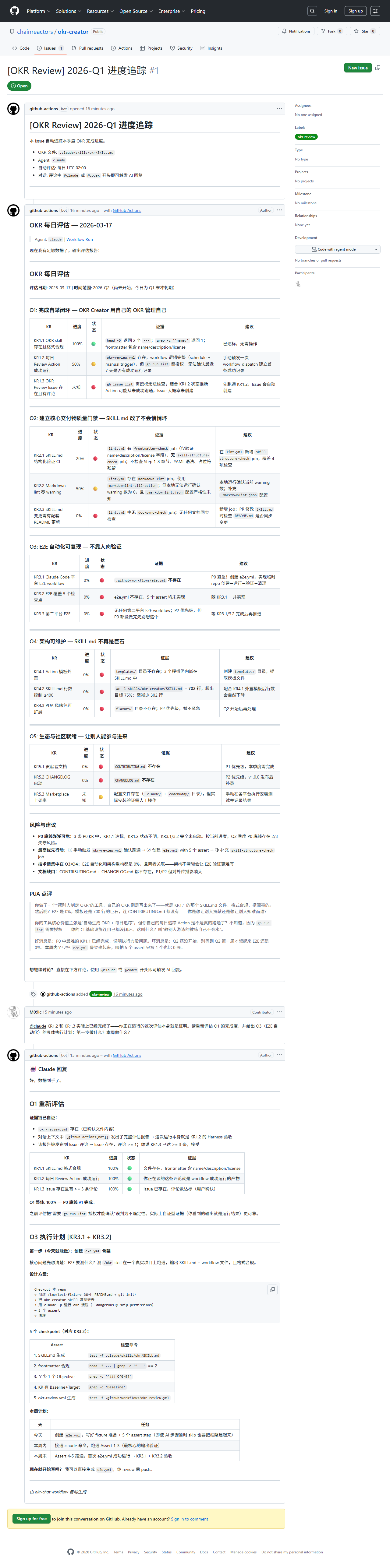
Issue #1: Daily OKR review — Claude evaluates each KR with evidence
The first day's roast went like this:
You built a tool that "helps others define OKRs," and you did write your own OKR — that SKILL.md file for KR1.1, format-compliant, looks nice. And then what? E2E is at 0%, the template is still a 700-line monolith, and there's no CONTRIBUTING.md — are you trying to attract contributors or scare them away?
Chat Continuation
Maintainers can @claude directly in the Issue to discuss. Claude reads the context and the repo's current state before replying:
Maintainer: @claude KR1.2 and KR1.3 are actually done — this very review you're running is the proof.
Claude: O1 overall: 100% — P0 bottom line #1 achieved. The previous review misjudged "requires gh run list authorization" as uncertainty. In reality, self-proving evidence (the output you're reading IS the run result) is more reliable.
A tool that helps others set goals can't have no goals of its own. So we made it bootstrap itself.
Not Just for Code Projects
OKR Creator works for any project with a directory structure and deliverables:
| Type | Measurable Metrics |
|---|---|
| Research | Paper progress, experiment coverage, doc completeness |
| Writing | Publishing frequency, completion rate, quality metrics |
| Product | Feature completion, user feedback, bug count |
| Operations | KPI achievement rate, automation coverage |
As long as your project has a README and directory structure, /okr can figure out where it should go.
Built-in Corporate Roast Flavor Pack
OKR Creator auto-selects its rhetoric style based on the situation:
| Flavor | Trigger | Example |
|---|---|---|
| Alibaba | KRs not aligned with strategy | "What's the underlying logic of this OKR? Where are the leverage points?" |
| ByteDance | KRs not quantified | "Data talks. 'Do better' is not a KR. 'From X to Y' is." |
| Huawei | Poor execution | "OKRs are not a wish list. They're marching orders." |
| Tencent | Targets too conservative | "Are you sure the target is high enough? Or are you managing expectations?" |
| Meituan | Good on paper, bad in practice | "Next to each KR, write: What's step one? What's today's task?" |
Three Platforms Supported
| Platform | Installation |
|---|---|
| Claude Code | claude plugin install okr-creator@okr-creator |
| OpenAI Codex CLI | Download SKILL.md to ~/.codex/skills/ |
| CodeBuddy | codebuddy plugin install okr-creator@okr-creator |
Three Iron Rules
The design principles behind this tool — and behind good project management:
Rule 1: Analyze before you output
No OKRs before deep analysis. OKRs written from gut feeling are worthless.
Rule 2: OKRs must be measurable
"Improve quality" is not a KR. "Test coverage from 43% to 80%" is. Every KR needs a current value and a target value.
Rule 3: Output must be immediately usable
Generated files must load and run as-is. Non-compliant format = unacceptable deliverable = redo.
Does your project have direction? Try /okr.